You take her, because she is beautiful, and you want her.
You call it love.
You take her, and she does not struggle or try to break
free. You call it love.
And you build her a house by the shore, and you do not
reprimand her for her odd ways; the strange songs she sings in her crying,
crooning tongue, and the way she always stares out at the sea. You are gentle
to her, and she does not complain. And she is still beautiful, and you still
want her. So you call it love.
You always ask her what she wants, what she needs, in
everything except the most important thing. You want to forget that she is a
captive, so you never ask if she wants to be free. You want her to be happy, so
you ignore the sadness in her eyes. You want her to love you, so you kiss her
salt-rimed lips and press your warmth into her cold body, and believe that her
tongue in your mouth means everything you want it to.
You want her to forget she is chained, and so you hide the
key. She smiles at you, now, and she does not object when you twine your
fingers through her dark hair. She is perfect and beautiful, even if she does
stare too much at the sea. When she bears your first child, you are overcome
with joy, and a little of the sadness lifts from her as the dark-eyed baby boy
is placed in her arms. His skin is soft and fair, and you do not notice the
slight webbing between his fingers and toes. You come to forget that she is
chained, and you forget where you hid the key.
The children (the years have flown and there are three of
them now, dark haired, eyes like the seals’, with sturdy chubby bodies made for
playing in the waves) swim in the ocean and catch fish with their bare hands, three
more links in the forgotten chains. You hear their laughter, and smile, and
never wonder why it is that your wife never laughs.
You have almost forgotten how this started, your family in
the cottage on the shore. You no longer taste salt on your wife’s tongue, or
feel any coldness on her skin. Her voice is familiar now, and the odd
inflections and rolling consonants that puzzled you at first cease to be noticeable
at all. She is still beautiful, and you are sure that she loves you.
One night, when the full moon is shining brightly, the seals
come in to shore, and cry like children in the waves. You have not seen a seal
since the day you took her. Your wife runs down to the strand and cries back to
them, speaking in the language that she still uses to sing to your children.
And fear runs through you.
You follow her out, and shout at the seals, and throw rocks
at them (seal skins are fetching a good price, now, but somehow you know better
than to bring out your gun). They dive into the waves, leaving the sea dark and
blank, and your wife collapses sobbing on the sand. You stroke her hair and
whisper words of comfort, and lead her back to the house, ignoring the way she
falls against you, as though she’s forgotten how to walk. (Long ago, you
supported her in the same way, and she left a trail of water behind her as you
walked her to your home). Inside, you pour her a dram of whiskey and watch over
her until she falls asleep.
She is quieter after that, and often you catch her walking
on the beach, looking out at the sea. Your fear grows, for you need her now,
and you believe that this is the same thing as love. She sleeps more often now,
and sometimes when you come home the children tell you that she has not been
able to get out of bed today.
You do not ask if she is sick.
The fourth child is born, and this one has yellow hair and
grey eyes, eyes the color of a stormy sea. She does not look like either you or
your wife, and for a moment, you wonder…. But you love your wife, and you put
this out of your mind, forget it as you have forgotten so much else. And the
child has one good effect, at least, for your wife seems happy again; she
smiles at the baby, and plays with the children, and your worries fade….
Until the baby is four years old, and wants to climb
everything: the rocks on the beach, the furniture, the walls….
And she climbs into the attic, back in the rafters, where
none of the other children ever tried to go.
You are out fishing when she tugs on her mother’s skirt and
asks the question: “Mother, why does Father keep an old fur coat in the
rafters?”
Her heart skips a beat. For through all the years, she has
never forgotten that she is a prisoner, nor has she ceased to feel her longing
for the sea. Her voice scrapes in her throat as she says, “Show me.”
And there in the darkest corner of the attic, cobwebs
clinging to her face and hair, she sees the bundle wedged between the rafters.
She reaches out with trembling fingers and takes it, and a shock goes through
her, like a stroke of lightning. Suddenly, she is alive again, alive after years
upon years of feeling like a corpse made to walk and talk, living in her own
grave… The pelt is still soft and smooth after all these years, and it smells
of oil and fish. For a moment, all she can do is stand there, holding it to her
cheek, remembering.
The children know that something has changed when she walks
down the stairs, holding the pelt to her like a baby. They stare at her with
wide, dark eyes, and she tries to smile for their sake, pitying them. “I must
go,” she says. “The ocean is calling me, and I must go home. You’ve felt it
too, haven’t you? The sea longing?”
They nod. The oldest, Ronan, says, “But we cannot live in
the ocean.”
“No.” She clutches the pelt to her, a voice in head crying
that she must go now, now, now! “You cannot, for you are not of the seal folk.
What I have given you is… not an easy gift to bear. But the tides will obey
you, and your fishing nets will be full, and—if ever you need me—truly need me—you
may call out to the ocean, and I will come.”
They are looking at her with sad, wise eyes—seal eyes—and she
feels both regret and pride when she realizes that they understand, that they
will let her go. “Tell your father…” Her fists clench as she thinks of you, as
she thinks of what you’ve done. “Tell him that I was never his for the taking.
And I will never be his again. Tell him that the seals will remember the wrongs
done to us. He will pay.”
She almost chokes, mouth twisting, and spits, “He doesn’t
know the meaning of love.” She looks at the boys, Ronan, who is thirteen (he
soon will be a man, she thinks) and Breen, who is eight. “Boys,” she says,
seriously, “Promise me this: that if ever you love someone, you ask them to
love you of their own free will. And if they do not, you must leave them be.”
“We promise,” they tell her. Breen is crying, and Ciara,
eleven, is trying to hold back her tears.
She doesn’t want them to be unhappy, but she cannot stay
here, in this tomb, any longer. “I love you,” she says, and hugs them one last time,
and walks through the door.
The children follow her, silent, to the water’s edge, and
watch as she drapes the pelt around her shoulders, as she dives into the waves.
After a moment, a seal’s head breaks the water. She gives
them a final look, then swims away, rolling and playing in the waves, before
she dives and disappears.
You come home to a silent house, and the accusing stares of
your children. You don’t believe them when they tell you that she’s gone, until
they show you the space in the rafters where the pelt used to be. When you want
to cry and rage, they tell you it was your own fault. That you didn’t really love her.
It takes a long time for this to sink in.
You stop fishing, for your nets always come up empty and
broken, and storms become unpredictable, the winds dangerous. You begin to
believe that this is the seals’ revenge. They
will not forget. They will make you pay.
And so you pay.
You wait until the children are grown and gone, off to be
fishers and sailors far away. And on a moonless night, you take your boat (old
now, and leaky) down to the ocean, rowing out across the black waters, away
from the protection of the bay.
Long ago, you took a seal woman, because she was beautiful,
and you wanted her. You called it love.
Now, when it’s far too late, you think that perhaps you did
not know the meaning of love. You hope that you know it now.
The boat is found a few days later, washed up on a beach far
from your home. It is empty.
The seals remember the wrongs done to them. And now, you
have paid.
“I have almost reached the regrettable conclusion that the Negro’s great
stumbling block in the stride toward freedom is not the White Citizens Councillor or the Ku Klux Klanner but the white moderate
who is more devoted to order than to justice; who prefers a negative peace which is the absence of tension to a positive peace
which is the presence of justice; who constantly says, “I agree with you in the goal you seek, but I can’t agree with your methods
of direct action”; who paternalistically feels that he can set the timetable for another man’s freedom; who lives by the myth of
time; and who constantly advises the Negro to wait until a “more convenient season.” Shallow understanding from people of
good will is more frustrating than absolute misunderstanding from people of ill will. Lukewarm acceptance is much more
bewildering than outright rejection.”
He wasn’t wrong. It is, sadly, still true today.
“…who is more devoted to order than to justice; who prefers a negative peace which is the absence of tension to a positive peace which is the presence of justice.” We talk about this in seminary all the time: peace that is won by one side holding its foot on the other side’s throat is not peace. When we pray for peace, we must pray for peace with justice, never at the cost of justice, made by silencing the oppressed.
Fellow white people, don’t just reblog or share mlk jr.’s more palatable “hate cannot drive out hate” type quotes and ignore the fact that he also said challenging things like this. We must hold ourselves accountable. We must not be lukewarm. And there is never a “more convenient season” to act to secure rights for all people – the time is now.
He also had a speech to the APA that openly called out white people for caring more about “riots” and damaged property than the fact that Black people were suffering under institutional violence.
He called out white people regularly for their lack of empathy for Black lives and their continuance to spout respectability at Black people than hold the white policymakers accountable for their racism.
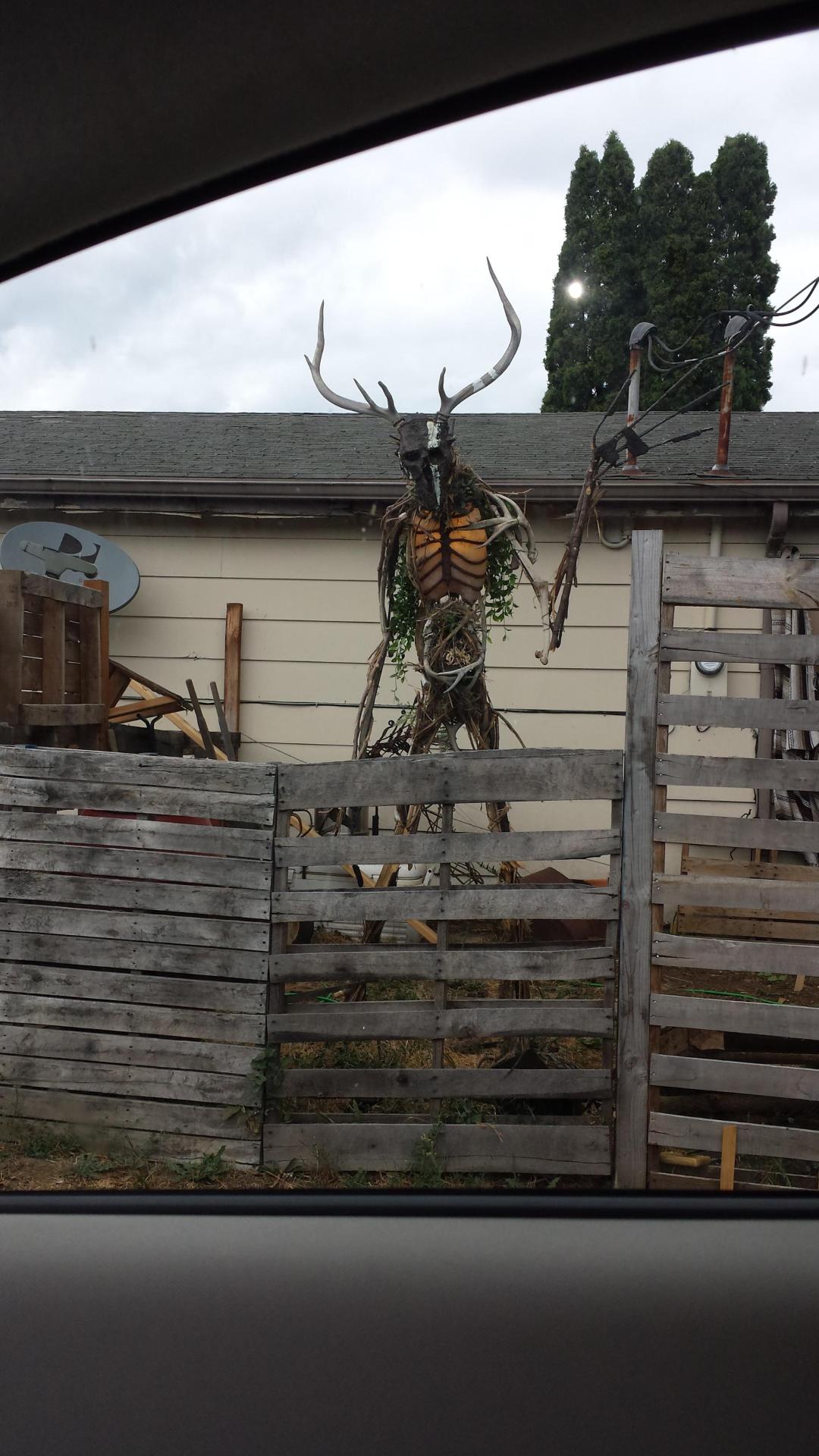
“HELLO NEIGHBOR STEVE, I WOULD LIKE TO INVITE YOU TO BARBEQUE ON THE EVE OF THE BLOOD MOON. I FEEL WE GOT OFF TO A BAD START.”
“NEIGHBOR STEVE, DO YOU NOT WISH TO PARTAKE OF THE UNCLEAN FLESH-MEATS OF PIGS AND THE POLLUTED ESSENCES OF TOMATO? PERHAPS YOU ARE A CAROLINA STYLE MAN, NEIGHBOR STEVE?”
“PUT THE GUN AWAY NEIGHBOR STEVE, YOU KNOW I SHALL ONLY RISE AGAIN WITH THE DAWNING OF THE MOON. WE HAVE BEEN THROUGH THIS MANY TIMES.”
“LOOK AT THIS PICTURE MY SON DREW OF YOU AND CHILD TIMMY, YOUR SON. ARE THEY NOT THE PICTURE OF PACT-MATES? THIS COULD BE YOU AND ME, NEIGHBOR STEVE.”
“YOU MISSED THE UNHOLY NEXUS OF POWER THAT IS THE KEY TO MY CORPOREAL FORM, NEIGHBOR STEVE. YOU WILL NEED TO RELOAD NOW, SO I WILL GO INSIDE TO MY HELL-WIFE AND PUT YOU DOWN AS A SOLID ‘MAYBE’.“
I have the feeling that the families get along great except for Steve. Like, the wives are baking (questionable) brownies together, the kids are playing together, Antler Guy occasionally takes Son and Timmy to school (no car, just carries them in huge swinging strides through a nexus of ungoldly sights in a swirling netherworld shortcut. Sometimes they stop for McDonalds). Hell-wife gave them a potted Audrey Jr., Steve’s wife (who I now christen Sharon) gave them a begonia.
One time Steve tries throwing holy water but all Antler Guy does is thank him, saying that no, Antler Guy isn’t Catholic but it’s the thought that counts, he is so kind to water his creeping deathshade vines regardless.
For Christmas Antler Guy gives Steve a case of ammunition. To be funny/sarcastically mean Steve gets Antler Guy the world’s most hideous Christmas sweater, singing light-up reindeer included. He immediately regrets it because not only does Antler Guy love it and wears it for several months, it will never need batteries because Antler Guy powers it with his own eldritch aura.
When they come back from a holiday to Hawaii, Steve is horrified to find out Sharon bought them matching Hawaiian shirts. He is even more horrified that his wife means it that if he doesn’t wear it he will forever sleep on the couch.
I want to expand on this, since I see it’s still passing around and the ideas have grown in my brainmeats.
What drives Steve up the wall and down the other side is how… normal… everyone treats the Abominations. (Yes, that is their last name. No, it is not a joke. Son was asked his last name for the standardized testing at school, had a quick conference with Timmy, and decided that Son Abomination sounded good, “Since my dad calls your dad the Abomination anyway and we can paint it on your mailbox just like the Henderson’s did theirs!”. Antler Guy agreed and did a lovely rendition of it for the mailbox, with only a few glyphs of soul-rending terror added to keep up to snuff.)
The Great Plant Exchange went beautifully, though the Audrey Jr. (named Aubergine for the lovely shade of purple poison that drips from her fangs) is on a diet at the moment. She was in cahoots with the cat and the dog to get into the good people food and ate two frozen turkeys all herself. Now she’s restricted to the hallway table to answer the phone and the door. (Steve actually likes her, and keeps slipping her hotdogs when Sharon isn’t looking. Their door-to-door salesman rates have dropped dramatically since she changed abodes.) Hell-wife has almost gotten the begonia to bloom and say it’s first words.
The homeowner’s association just loves the Abominations. All paperwork stamped and dotted, in on time and in triplicate. Antler Guy likes filing, says it reminds him of his old job. There is a resident who spent 20 years as a lawyer and they have long, animated conversations about all sorts of things that make Steve swear to never need legal counsel.
Hell-wife joined the PTA and spearheaded a committee to fundraise in the fall with a haunted house. It was a county-wide hit, though the claims that a particularly rowdy group had been deliberately lost in a timeslip to the Outer Doors Of Chaos was firmly rebuffed. Most young people nowadays, it was agreed, just couldn’t appreciate flute music.
Antler Guy really does try to connect with Steve. The surprise birthday party was perhaps a bit much, given that most participants do not have the ability to suddenly materialize in front of the guest of honor to give them a hug. Sharon assured them that Steve normally screams on his birthday, and the remains of the cake were heartily enjoyed by all. (A plate was saved for Steve once he came down from the treehouse.)
After the Hawaii trip (which was a present for his birthday) and the Matching Shirt Ultimatum (which was Sharon’s attempt at patching things up with Antler Guy, he really was sad about the birthday screaming), Steve finally grabs his courage in both hands (plus the shotgun, which let’s face it is about as useful as a teddybear at the moment but it does comfort him) and confronts Antler Guy, about why such a group of……Abominations could possibly come to his quiet slice of suburban bliss.
“……BUT NEIGHBOR STEVE, WE HAVE ALWAYS BEEN HERE.”
“No no no, I read it in a book! Don’t you have to be invited or something?!”
“WELL YES, TO THE HUMAN WORLD. BUT THIS IS NOT THE HUMAN WORLD AS YOUR THREE-DIMENSIONAL BRAIN PERCEIVES IT.”
“What the hell does that mean?!!”
“DID YOU NOT KNOW, NEIGHBOR STEVE? LEGALLY SPEAKING, ALL OF THE VASTNESS OF HUMAN SUBURBIA IS, IN FACT, A PART OF HELL.”
“……..”
“THE FLAMINGOES ARE THE BOUNDARY MARKERS. IT WAS DECIDED THAT THE FLAMING SKULLS WERE TOO KITSCHY FOR MODERN TIMES.”
Reblogging cause I kind of want more of this….
Since you asked nicely ^_^
Antler Guy, as one may have noticed, is a calm sort of fellow. In the face of human atrocities he displays a curious Zen sort of state of mind. Timmy asks Son if he’d ever seen his dad angry, and Son hasn’t. (When asked, Timmy says that yeah his dad gets mad, but it’s like the Fitz-Simmon’s chihuahua down the street- mostly high-pitched noise and occasionally TV remote chewing. Sharon replaces the poor thing every 3 months or so.) When pressed (gently, at the monthly book club, and with many cups of tea and at least one daiquiri), Hellwife admits that this comes from serving many years at his old job.
After the revelation of the nature of his neighborhood, Steve has not been overtly mean to Antler Guy. Not yet in the realm of friends, but vastly better than before. No more holy water, no more shotgun blasts. (Still the occasional jumpscare, but Antler Guy really can’t help that part.) They even occasionally share news over the fence as Antler Guy trains the creeping deathshade vines in proper oral hygiene, and Steve waters his lawn (and occasionally slips a goldfish cracker to a deathshade vine that looks particularly adorable. Aubergine has trained him well.)
Which is how Antler Guy learns about the peeping tom that’s been plaguing the adjacent streets. Apparently the pervert has been getting bolder, and rattling doors. He almost broke into one apartment, whose occupants were a single mother and her daughter, Mildred. Millie, a shy girl who is a great horror fan and firm friends with Timmy and Son, had missed school because of it.
Steve knew because Sharon had told him, on her way to deliver a tuna casserole and a double batch of brownies to the pair. (Sharon has been dubbed the unoffical mob boss of the Mother’s Mafia. She is quite pleased with this title.) He tells her to wait, confers briefly with Aubergine, and sends her along with, “Only as a loan, you know, but Auby wants to stretch her roots and she’d probably like getting all ribboned and curled anyway. Little girls still do that, right?” She has strict orders to bite anyone that makes Millie or her mother cry. (Steve is dubbed the official neighborhood marshmallow for this. The bookclub buys him a jar of marshmallow fluff in commemoration.)
He turns to look at Antler Guy, and freezes, much as a chihuahua will when faced with a hungry hellhound.
Steven makes a very ungraceful exit when space starts bending around Antler Guy’s still, unmoving form.
When Steve sees a shadowy form in his back yard when he gets up to pee that night, there’s no hesitation. He grabs the shotgun from the cabinet and peeks out the back door window.
Just in time to see a nebulous form of soul-wrenching terror engulf the man reaching for the door handle. A sliver of moonlight reveals a very familiar eyesocket. After a moment (and a sincere prayer of thanks that he had already peed, cause otherwise he’d have done it then and there) Steve opens the door. The nebulous form freezes, reality bending around the edges.
“Good. G’night then. Oh, and if Hellwife has an extra Audrey Jr. that needs a home, let me know. Millie likes Aubergine a lot but Augy’s just too big for the apartment. Dunno if they come in miniatures though.”
There are no more peeping reports. Millie brings back Aubergine and spends an entire afternoon teaching Steve the particulars of Augy’s new “hairstyle” (a gravity-defying mass of teased tendrils, ribbons, and barrettes) in between games of tag and hide-and-seek with Timmy and Son.
When Antler Guy and Hellwife present her and her mother Beatrice with a tiny Audrey Jr. (”pOOr ThinG Is a ruNT And wOn’T geT MorE Than A FooT taLL, BEa, aNd NeeDS a New FRiEnD”, assures Hellwife), both mother and child burst out crying. Millie names it Bella, after Bella Lugosi, and shows it to the excited group of boys (Steve and Augy included).
IT GOT SO MUCH BETTER!!!!
Life in a subdivision partly populated with eldritch and possibly magical (officially classified as “extra-dimensional”, for even when faced with the physics-defying nature of their new co-habitating citizens the government cannot bring itself to acknowledge them as “magic wielding hell-beasts”, as some high-ranking staff members initially suggested) goes on fairly normally.
Sure, there are a few hiccoughs. The creeping deathshade vines get a stern talking to about appropriate afternoon snacks (”NOT the Fitz-Simmon’s chihuahua, I don’t care how much he has it coming or what he excreted where, now spit it out!”), Aubergine sheds all her leaves at once and snowballs the house (but does helps sweep up afterwards), and moonrise is a good time to watch the night-gaunts fly by (but on moondark it’s best to stay inside, no matter how prettily they glow. They’re somewhat similar to fireflies, and don’t always check to see if their partner glows as well. It wouldn’t be as much of a problem if they didn’t dive mid-coitus and drop just above the ground.)
While the neighborhood in general is accepting of the Abominations, when things get to be a bit much they tend to come to Steve. Since meeting Beatrice and Millie (and the formation of the Terrifying Triad known as Millie, Son, and Timmy) Steve is the adult human male most comfortable dealing with Antler Guy on the whole street. (Sharon as U.M.B. is widely held to have, well, steel-whatever-the-hell-she-wants, and Timmy is known to run over to Antler Guy and ask for rides through “that wobbly grey place, you know, the one with the REALLY BIG alligators?”. Still, the courtesies must be observed.)
So when a writhing sparking ball of snarling terror and teeth takes up residence in the Manzo’s tool-shed, and when Animal Control refuses to come (the street is banned due to a run-in with the deathshade vines), Steve is called. Having heard the description, Steve brings Antler Guy.
When they get there, Mr. Manzo is forcibly holding the door shut. Unholy yowling is coming from inside. At a gesture from Antler Guy, Mr. Manzo leaps away, and the doors blast open.
A 150 pound ball of whimpering, flaming something hits Steve and knocks him on his ass. The whimpering, flaming something proceeds to slobber all over Steve, his shirt, his pants, and a decent portion of grass in between distressed yelps.
“GACK!”
“NEIGHBOR STEVE, ARE YOU IN DISTRESS?”
“GAAACKLEARGHSPLUH- DOWN boy, HEEL, that’s a good- Antler Guy, what is this?!”
“I BELIEVE IT IS A HELLHOUND, NEIGHBOR STEVE.”
“Good grief, I didn’t know they came this big and…..and….. Guy?”
“YES NEIGHBOR STEVE?”
“Is he supposed to be…..skinless?”
“YES NEIGHBOR STEVE. THIS VARIETY WAS BRED TO BE LAP DOGS. THEIR FLAME IS MOSTLY WITHOUT HEAT, AND THEY HAVE NO SKIN FOR THOSE WHO ARE ALLERGIC.”
“…….laPDOG?!”
“YES NEIGHBOR STEVE.” Antler Guy lays a hand on the hellhound, who tries to burrow further into Steve with little success. “HE APPEARS TO HAVE BEEN RECENTLY WEANED. IT WILL TAKE TIME FOR HIM TO GROW TO HIS FULL SIZE.”
“……”
“THE SMALL BREEDS GROW MORE SLOWLY.”
A vile hissing emanates from the shed. (Mr. Manzo has long since fled for the safety of his kitchen.) As Steve attempts to calm the frantic hell-puppy, Antler Guy investigates. He reaches one long hand in behind the riding lawnmower and….. winces.
“NEIGHBOR STEVE?”
“Yeah- I’m right here, uh, doggie, not going anywhere- Guy?”
“I APPEAR TO HAVE AN…. ATTACHMENT.”
Steve is awed at the tiny ball of white fluff attached to one long, thin finger. He didn’t know that Antler Guy’s fingers COULD be bitten, much less by a tiny kitten.
Which is how Steve and Sharon got Clifford (”Aww c’mon Sharon, how could I pass that one up?”), and Antler Guy and Hellwife get Fluffy (”NEIGHBOR STEVE ASSURES ME IT IS A TRADITIONAL TITLE.”)
This might be the most amazing thing that ever crossed my tumblr dash
Thought of the day (while reading a “gender marketing” translation with painfully outdated views): I am really, really sick of us only talking about “gender” when women are involved.
A surprising number of important realizations could be made if we develop the habit of talking about gender dynamics even – perhaps especially – in the context of all-male or mostly-male groups.
How does it affect productivity, public image, collaboration, negotiating, client acquisition, etc. to have any group of people involved be entirely men? What effects does this drastic gender imbalance cause in its environment?
LET’S TALK ABOUT GENDER AND MEN, PEOPLE. Gender is not an exclusively female domain.
Me, interviewing the director of basically any film ever: “So let’s talk about the extreme gender imbalance in the casting of this film. What was the thinking behind that? Was there a particular statement you were trying to make, a satirical observation on the politics of society, perhaps? That kind of came out of left field, when we watched the film and all the parts but one were men. Can you tell us a little about the background of that?”
Director: “Um… I didn’t actually consciously think that much abou–”
Me, interrupting: “Come now, don’t be modest! That was a fascinating artistic decision! The drastic disparity between the number of men and the number of women in the film makes it clear to even the most casual viewer that gender is a central theme in this story. Can we delve into that a little bit further?”
Director: “…”
This would be a fun tack to take in regard to race, too.
“I noticed something very interesting about your film, which is that every single one of the leading roles is played by a white actor. Clearly there’s some conceptual message you want to communicate with this creative choice. Could you talk about that?”









 As small as the world